The right implant restoration depends on the number and pattern of missing teeth, the condition of your bone and gums, your bite, and whether you want fixed or removable teeth. By the end, you will know how single implants, implant-supported bridges, overdentures and fixed full-arch teeth differ, and which questions to take to your consultation.
Key takeaways
- One missing tooth often uses one implant, abutment and crown.
- A bridge or removable partial denture can replace teeth without one implant per gap.
- Bone volume, gum health and medical history affect implant timing.
- Ask for the proposed restoration, implant count, grafting needs and maintenance plan.
Match the restoration to the pattern of tooth loss
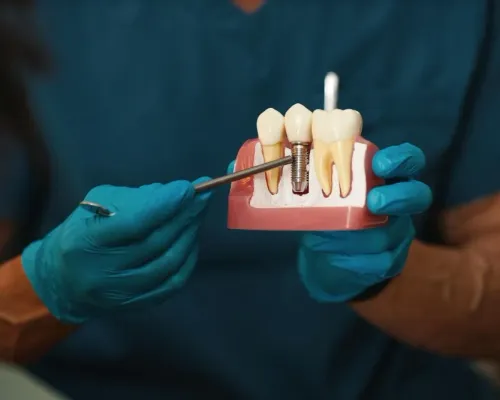
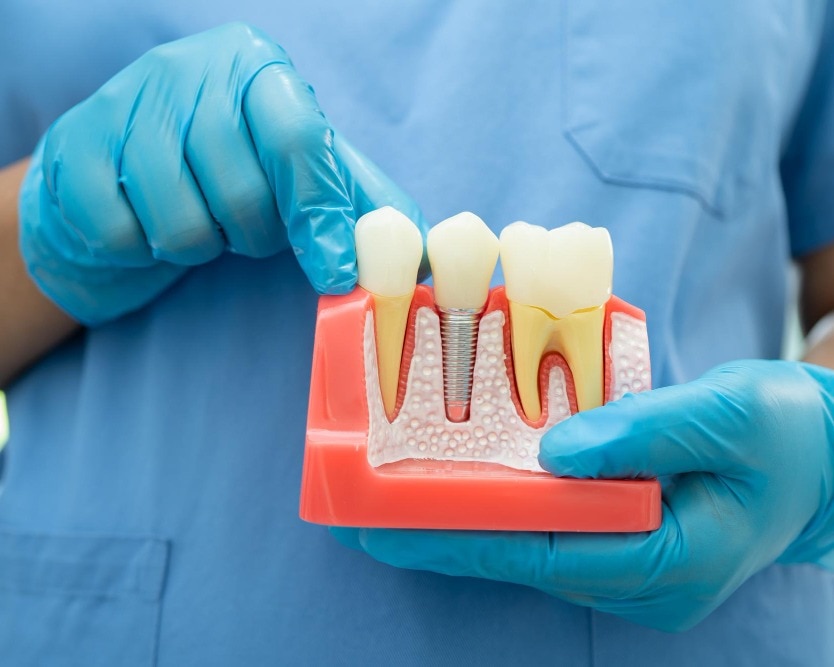
The number and pattern of missing teeth determines the restoration—not a rule that assigns one implant to every gap. One missing tooth usually suits a single implant, abutment and crown: the fixture replaces the root, the abutment connects the parts, and the crown appears above the gum.
| Option | What it means | When it applies |
|---|---|---|
| Single-tooth implant | One fixture supports one crown without cutting down neighbouring teeth | One missing tooth with suitable bone and healthy surrounding tissues |
| Implant-supported bridge | Two or more implants support several connected crowns | Several adjacent missing teeth when implant positions, bone, bite forces and hygiene access permit |
| Implant-retained overdenture | A removable denture clips onto implants for added retention | Several missing teeth or a toothless jaw when you want removable teeth with less movement |
| Fixed full-arch prosthesis | A complete row of replacement teeth stays attached to multiple implants | A completely toothless jaw when anatomy, hygiene ability and expectations suit a fixed result |
For a toothless lower jaw, a removable overdenture retained by two implants is a predictable minimum-standard option for many patients. A fixed full-arch restoration needs more complex planning and cleaning.
The right dental implant options in Nashik depend on bone volume, gum health, bite forces, smoking, budget and whether you prioritise fixed teeth or easier removal.
Choose between a single implant, bridge and removable partial denture
A single tooth implant in Nashik is usually the better choice when one tooth is missing, the neighbouring teeth are healthy, and you want a fixed replacement without reducing those teeth for support. It also suits patients who can maintain careful cleaning and accept staged treatment rather than an immediate final tooth.
| Option | What it involves | Best fit |
|---|---|---|
| Single implant | An implant fixture replaces the root, an abutment connects the restoration, and a crown replaces the visible tooth | One missing tooth with adequate bone and healthy gums |
| Conventional bridge | A replacement tooth is joined to crowns fitted over the teeth beside the gap | A faster fixed result when adjacent teeth already need crowns or cannot support themselves |
| Removable partial denture | Replacement teeth sit in a removable acrylic or metal framework, often using clasps or rests | Several missing teeth, limited bone, budget constraints, or a preference for removal |
A bridge can be the practical choice when the supporting teeth have large fillings, cracks, or existing crowns. Cutting down sound enamel solely to replace one tooth is its main disadvantage; an implant avoids that preparation but requires surgery, healing for osseointegration, and sufficient bone.
Choose a removable partial denture when you need a non-surgical or lower-cost option, or when the missing-tooth pattern makes a fixed restoration difficult. It can move during chewing, collect food around clasps, and must be removed for cleaning.
An implant is the stronger candidate when you prioritise a fixed tooth and long-term preservation of neighbouring teeth.
Plan multiple missing teeth without assuming one implant per tooth
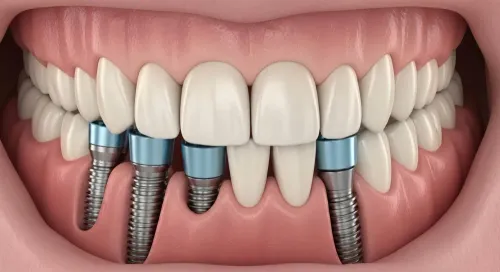
The number and pattern of missing teeth determine whether you need one implant per tooth. Separate implants with individual crowns suit non-adjacent gaps, or adjacent gaps where independent cleaning, appearance and bite control matter. Each unit has its own fixture, abutment and crown, without joining the restorations.
| Option | What it means | When it applies |
|---|---|---|
| Separate implants and crowns | One implant replaces each missing root and supports an individual crown | Use for non-adjacent spaces, suitable bone at each site, or when independent teeth improve cleaning and appearance |
| Implant-supported bridge | Two or more implants support a connected row of crowns | Use for several adjacent missing teeth when implant positions, bone volume, bite forces and hygiene access support the planned bridge |
| Implant-retained denture | Implants hold a removable denture securely while you remove it for cleaning | Use when many teeth are missing, placing an implant for every tooth is unsuitable, or reduced bone and cleaning needs favour a removable design |
An implant-supported bridge can replace three or four adjacent teeth with fewer implants than teeth being replaced. It is not automatically the better option: a poor implant position, heavy bite or inaccessible underside can make cleaning and long-term maintenance difficult.
An implant-retained denture suits a wider span of tooth loss when you want more stability than a conventional denture but do not need fixed teeth. Ask how many implants are planned, whether the denture will be removable, and how the gums and implant surfaces will be cleaned.
Discuss these trade-offs when comparing multiple tooth implants in Nashik.
Check bone, gums, health and timing before committing
Eligibility depends on more than the missing tooth. An implantologist in Nashik will examine your gums, check neighbouring teeth, assess bite forces and review a periapical X-ray or CBCT scan to measure bone height, width and nerve or sinus position. A periodontal infection must be treated before surgery.
Your medical history also matters. Tell the clinician about diabetes control, smoking, blood thinners, osteoporosis medicines such as bisphosphonates, immune problems and previous radiation to the jaws. Poor hygiene or uncontrolled medical conditions can delay healing and increase the risk of peri-implantitis, which damages the gum and bone around an implant.
| Timing choice | What must be true | What can change the plan |
|---|---|---|
| Immediate placement | The socket has usable bone, healthy soft tissue and enough stability after extraction | Acute infection, a major bone defect or poor stability can require delay |
| Delayed placement | Infection or extraction damage has settled and the site is ready | Bone grafting may add several months before implant surgery |
| Immediate loading | The implant has strong primary stability and the temporary tooth can be kept out of heavy function | It is not the default for every single-tooth or multiple-tooth case |
The final crown, bridge or denture usually follows osseointegration, after the implant bonds with bone. The interval depends on stability, bone quality and grafting; ask for the provisional and final-tooth dates in writing, plus the maintenance schedule for examinations and professional cleaning.
Use the consultation to compare the proposed plan
Before accepting a plan, ask an implantologist in Nashik for choosing dental implant options to explain why that design fits your bone, gums, bite and daily routine. Do not approve a treatment that names the number of implants but not the restoration they will support.
Ask these questions:
- Will separate crowns, an implant-supported bridge or an implant-retained denture give the best result for my missing-tooth pattern?
- Do I need CBCT, or are two-dimensional X-rays sufficient? Which nerve, sinus or bone measurement affects the plan?
- Do I need ridge preservation, bone grafting or sinus augmentation, and how many extra months, visits and surgical risks will that add?
- What happens if I smoke, and what cessation plan do you require? Is my diabetes controlled well enough for predictable healing?
- When will you place temporary teeth and final teeth, and what happens if healing is slower than expected?
| Option | What you receive | Compare before choosing |
|---|---|---|
| Fixed crowns or bridge | Teeth remain in place | Cleaning access, bone support, surgery and repair if a component fails |
| Removable overdenture | You remove it for cleaning and sleep | Stability, relining, attachment maintenance and chewing comfort |
| Full-arch fixed teeth | A non-removable prosthesis | Higher cleaning demands, greater surgical commitment and repair access |
At Dr. Bhonsale's Dental Clinic & Implant Center, ask to compare photographs, scans, a wax-up or provisional design, and the cleaning routine for each option—not just the final smile. That makes the fixed-versus-removable decision practical.
Related services
Replacement Of Missing Tooth Or Teeth Dental implants are permanent solutions for missing teeth, designed to mimic natural tooth roots and provide a strong foundation for fixed or... View service → |
Full mouth rehabilitation is a comprehensive approach to restore and rebuild a patient’s entire oral function and aesthetics. View service → |
Frequently asked questions
Does every missing tooth require a separate dental implant?
No. Multiple missing teeth can sometimes be restored with fewer implants supporting a fixed bridge, depending on bone, spacing and bite.
How do you choose between a single implant, bridge and removable partial denture?
Compare stability, tooth preparation, surgery, cleaning, appearance, maintenance and suitability for your tooth-loss pattern and oral health.
What must an implantologist check before recommending treatment?
The evaluation should cover bone volume, gum health, remaining teeth, bite, medical history, smoking, oral hygiene and the timing of any extractions or grafting.
What should you ask during an implant consultation in Nashik?
Ask which restoration is proposed, how many implants are needed, whether grafting is required, what alternatives exist, how long treatment takes and how the result will be maintained.
Keywords