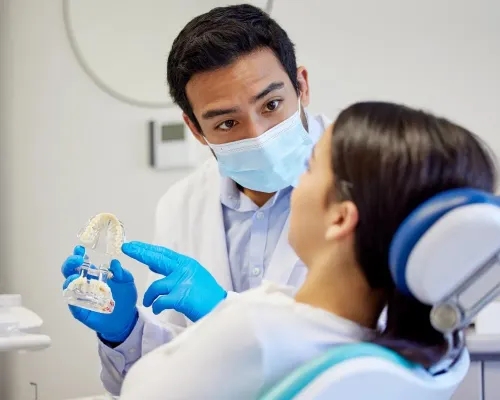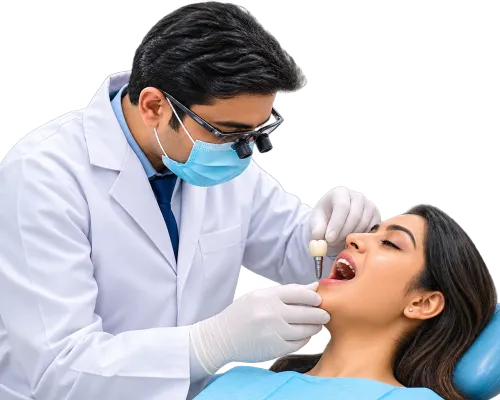
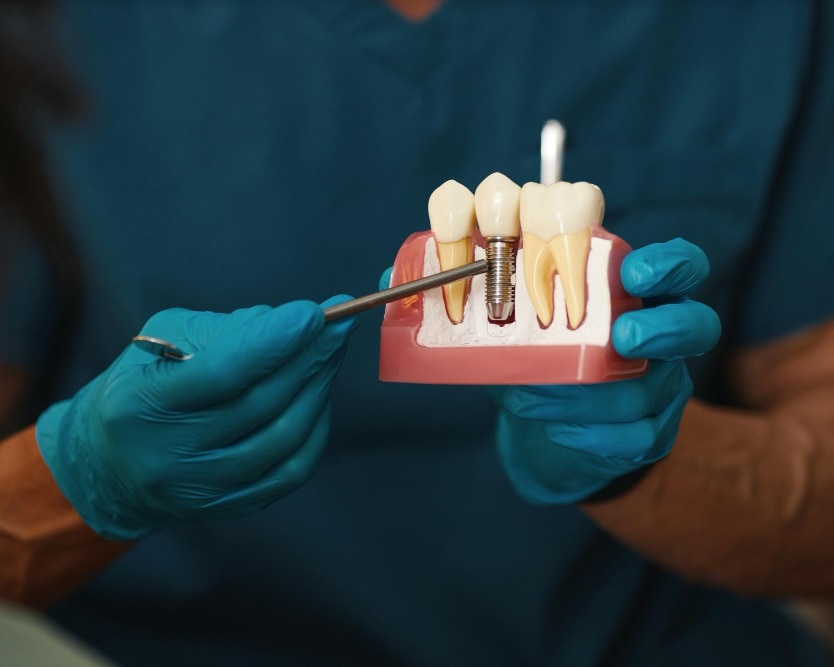
The better choice depends less on the label on the clinic sign and more on who diagnoses your case, plans the final tooth, performs surgery, manages complications and provides follow-up. By comparing qualifications, case experience, imaging, treatment stages, alternatives, total costs and maintenance arrangements, you can choose the right clinician for your needs.
Key takeaways
- Ask who will place the implant and who will restore it.
- Request a written plan explaining whether a CBCT scan is necessary.
- Compare implant systems, components, stages and aftercare—not only the quoted price.
- Choose another option when bone, health or maintenance makes implants unsuitable.
What an implantologist is—and how that differs from a general dentist
“Implantologist” is not, by itself, a universally standardised postgraduate specialty title in India.
If you are comparing an implantologist in Nashik or general dentist for implants, verify Maharashtra State Dental Council registration, recognised postgraduate training and documented experience rather than relying on the label “dental implant specialist in Nashik.” A general dentist can place implants after suitable training.
| Option | What to verify | Scope to clarify |
|---|---|---|
| General dentist | Registration, implant courses and continuing education | Routine cases and referral limits |
| Implant-focused clinician | Prosthodontics, periodontics or oral and maxillofacial surgery training | Surgical, restorative or both |
| Multidisciplinary team | Named clinicians and referral arrangements | Coordinated diagnosis, surgery and restoration |
The key question is who performs diagnosis, implant placement, bone grafting or sinus surgery, abutment selection, and the final crown or bridge. Implant planning must start with tooth position, crown shape, bite and cleanability; placing an implant where bone exists but the crown cannot be maintained is a planning failure.
Ask these measurable questions:
- How many implants have you placed, and how many were full-arch cases?
- How many bone grafts and sinus lifts do you perform or refer?
- Who treats previous implant failures and surgical complications?
- Which implant system, model and components will you use?
- Who designs and fits the crown, and are surgical and restorative care coordinated?
Which cases need specialist involvement and which scans are justified
Specialist assessment is warranted for insufficient bone, severe ridge resorption, planned bone grafting or sinus lifting, uncontrolled diabetes, active gum disease, heavy smoking, complex bite problems, previous implant failure, full-arch treatment, or an implant site near the maxillary sinus or inferior alveolar nerve.
| Scan | What it shows | When it is justified |
|---|---|---|
| Periapical or panoramic X-ray | Tooth roots, bone height and obvious pathology | Straightforward single-implant planning |
| CBCT | Three-dimensional bone, sinus, nerve and ridge anatomy | Grafting, severe resorption, multiple implants, complex aesthetics, or anatomy that could change surgery |
A CBCT is not automatic for every dental implant in Nashik: it adds radiation and cost, so request a reason tied to the treatment plan. Before surgery, the clinician should review your medical history and medicines, examine your mouth, record periodontal pockets and bleeding, and treat decay or infection.
Control periodontitis and improve plaque removal first; an implant does not remove the bacterial risk that damaged natural teeth.
Ask whether uncontrolled diabetes has been stabilised and whether smoking cessation is required. Delay elective implant surgery during pregnancy, while the jaws are still developing, or until healing after head-and-neck radiation has been assessed. Discuss medicines that affect bone healing, including antiresorptive drugs, before changing anything yourself.
A dental implant specialist in Nashik should also explain who will provide maintenance if plaque control remains inadequate.
What the treatment timeline really includes
A predictable dental implant in Nashik starts with restorative planning, not drilling. The clinician first decides the tooth position, crown shape, bite, appearance and cleaning access, then chooses the implant position and surgical approach.
An implantologist in Nashik may place the fixture, while a prosthodontist or restorative dentist designs and fits the abutment and final restoration; one clinician can perform both roles, but ask who is responsible for each.
- Consultation, examination, X-rays or CBCT when justified, and a written restorative plan.
- Extraction of the damaged tooth, followed by healing when infection, bone loss or soft-tissue damage makes immediate placement unsuitable.
- Bone or tissue grafting when the ridge cannot support an implant in the planned position; graft healing can add months, cost and surgical morbidity.
- Implant placement, followed by osseointegration, the period in which bone bonds to the implant.
- Abutment placement after integration, then delivery of the final crown, bridge or denture.
Immediate loading or same-day provisional teeth require strong primary stability, suitable bone and controlled occlusion. You must also follow a soft diet and attend scheduled reviews; excessive early loading can disrupt integration.
Ask why each healing interval, graft or antibiotic is proposed. Routine antibiotics do not prove specialist care: the dentist should state the indication, drug, timing and alternatives.
When an implant is not the best choice
A severely damaged natural tooth is not automatically an implant case. If root-canal treatment can remove infection and leave enough sound tooth for a crown, saving it avoids implant surgery and preserves your natural periodontal ligament.
| Option | Surgery and preparation | Function, cleaning and duration | Maintenance and cost |
|---|---|---|---|
| Root-canal treatment plus crown | No implant surgery; the tooth is drilled and restored | Fixed chewing function; clean like a crowned tooth; often quicker than an implant | Crown and root-treated tooth can fracture or need retreatment |
| Conventional fixed bridge | Adjacent teeth are reshaped | Fixed and usually quicker; floss threaders or interdental brushes are needed | More tooth structure is sacrificed; replacement costs arise |
| Resin-bonded bridge | Little or no preparation; no implant surgery | Fixed, but bonding can detach; suitable cases only | Easier to replace, but less tolerant of heavy biting |
| Removable partial denture | No implant surgery; clasps or rests may require preparation | Removable for cleaning; chewing feels less natural | Lower initial cost, but adjustment and replacement are expected |
| Implant crown | Surgery; possible grafting or sinus treatment | Fixed after healing; requires meticulous cleaning; longest pathway | Component, crown and professional maintenance costs continue |
Whether you choose an implantologist in Nashik or a general dentist for implants, ask for total costs, including grafting, abutment, crown and complications. A dental implant in Nashik is not risk-free: infection, failed osseointegration, nerve injury, sinus problems, bone loss, loose components, chipped crowns and front-tooth aesthetic compromises can occur.
Reported 10-year survival of about 94.6% means the implant remains present, not that its crown, appearance or future costs are guaranteed. Smoking, uncontrolled diabetes, untreated periodontitis and poor plaque control increase risk.
How to compare an implant centre in Nashik before accepting a quote
A low quote can cover only the titanium fixture, leaving you to pay separately for surgery, abutment and crown. Compare each implant centre in Nashik against the same checklist.
| Check | Ask for | Warning sign |
|---|---|---|
| Credentials | Maharashtra State Dental Council registration, postgraduate training, implant courses and case experience | “Implantologist in Nashik” used as the only qualification |
| Planning | Periodontal assessment, surgical equipment, CBCT access and informed consent | Scan or treatment plan offered without explaining why it is needed |
| Safety | Instrument cleaning, autoclave sterilisation, sealed packs and infection-control procedure | Antibiotics presented as proof of specialist care |
| Team | Named surgeon, restorative dentist, dental laboratory and emergency contact | No clear person responsible for complications |
| Follow-up | Review schedule, radiographs when indicated and maintenance pathway | Care ends when the crown is fitted |
Request a written plan naming the implant brand and model, number of implants, extraction, grafting or sinus augmentation, temporary teeth, sedation, abutment, crown, medicines, follow-up visits, warranty exclusions and complication fees. Ask whether the quoted dental implant in Nashik price includes every stage, not just the fixture.
If evaluating Dr. Bhonsale's Dental Clinic & Implant Center, ask who handles surgery, restoration and emergencies.
Related service
Replacement Of Missing Tooth Or Teeth Dental implants are permanent solutions for missing teeth, designed to mimic natural tooth roots and provide a strong foundation for fixed or... View service → |
What happens after the crown is fitted
A fitted crown is not the finish. Brush twice daily, clean around the implant and beneath bridges or fixed dentures, attend professional maintenance visits, and have radiographs when examination indicates a need. An implant centre in Nashik should explain this recall plan clearly.
Peri-implant mucositis affects soft tissue without progressive bone loss; peri-implantitis includes inflammation with supporting-bone loss. Seek assessment for:
- Bleeding when the area is probed or cleaned
- Swelling or pus
- Increasing probing depths
- Bone loss on a radiograph
Expect multiple appointments, soft foods after surgery, healing restrictions, transport after sedation, medication instructions, smoking changes and long-term recall. These are part of treatment, not optional extras.
When comparing an implantologist in Nashik or general dentist for implants, ask: Who is the emergency contact? Who treats a loose component or chipped crown? Who provides continuing maintenance after the restoration?
Frequently asked questions
What is the difference between an implantologist and a general dentist?
“Implantologist” is not a universally standardised postgraduate specialty title in India. Compare the clinician’s implant training, experience with your case, surgical and restorative roles, and treatment plan rather than relying on the label alone.
When should a dental implant case involve a specialist?
Seek specialist involvement for extensive bone loss, sinus-related planning, nerve-risk areas, multiple implants, full-arch rehabilitation, complex medical histories or a failed previous implant. Straightforward single-tooth cases can still require careful assessment by a suitably trained dentist.
Which scans are justified before a dental implant?
A clinical examination and dental radiograph establish basic information. Ask for CBCT when three-dimensional bone width, height, sinus position, nerve location, graft planning or multiple-implant positioning cannot be assessed safely with two-dimensional imaging.
How long does dental implant treatment take?
The timeline includes consultation, planning, any extraction or grafting, implant placement, healing, abutment steps, crown fabrication, fitting and review. The duration depends on healing, bone procedures, infection control and whether temporary teeth are needed.
When is a dental implant not the best choice?
An implant may be unsuitable when bone cannot support it without disproportionate grafting, active gum disease or infection is untreated, medical conditions are poorly controlled, smoking affects healing, or you cannot maintain regular cleaning and reviews.
Keywords