A crown or bridge quotation can cover far more than the laboratory-made restoration. You need to know which examinations, preparatory treatments, temporary teeth, fitting appointments, and aftercare are included before comparing options or approving a treatment plan.
Key takeaways
- Confirm disease treatment and tooth support before accepting a crown or bridge plan.
- Ask whether scans, impressions, temporary teeth, fitting, and adjustments are included.
- Compare material, laboratory, warranty, replacement, and follow-up charges in writing.
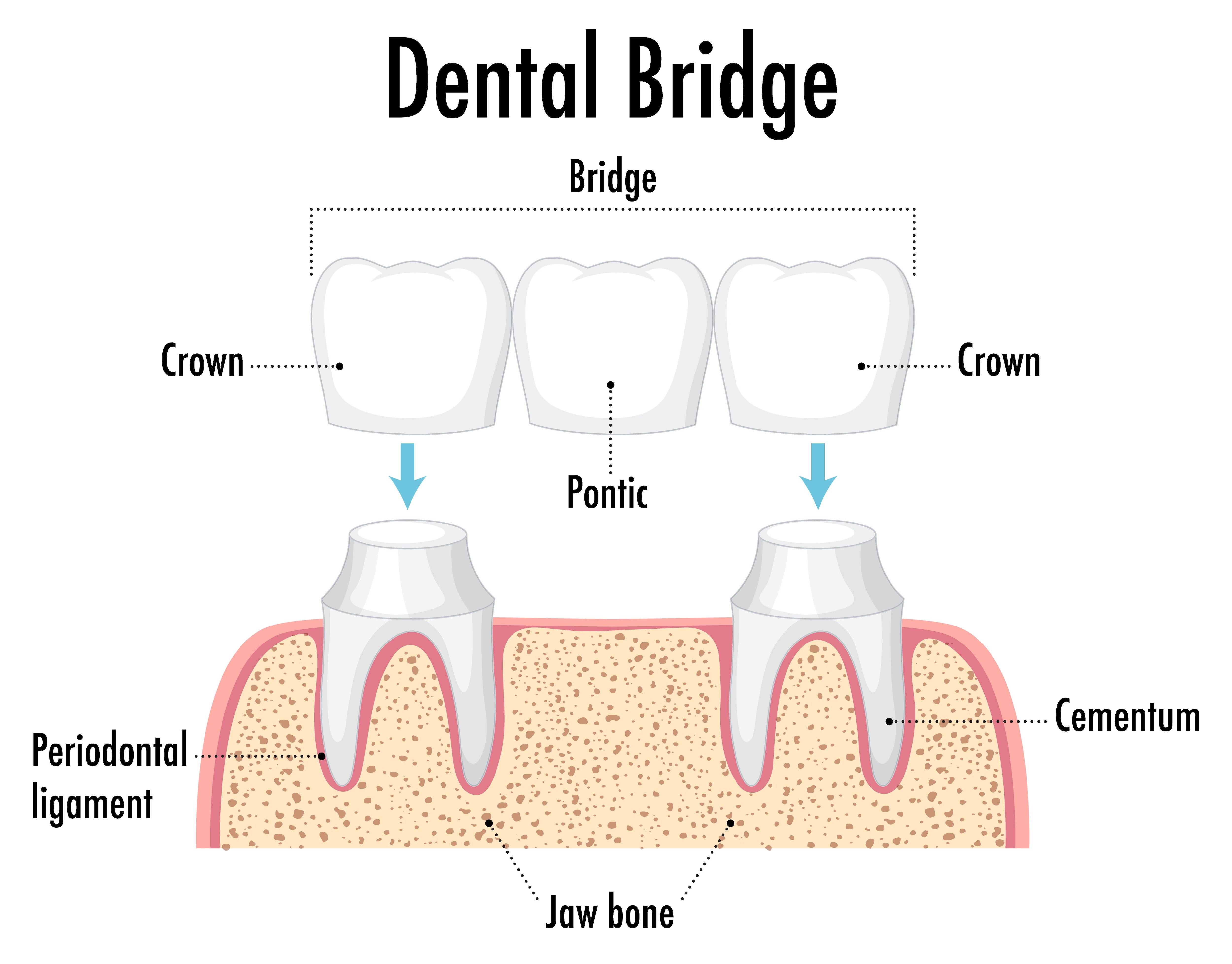
- A conventional bridge uses prepared abutment teeth to hold a replacement pontic.
What the First Crown or Bridge Assessment Includes
A dentist checks two things before recommending a crown or bridge: whether the tooth or supporting teeth can carry the restoration, and whether disease must be treated first. A crown covers one prepared tooth; a conventional bridge replaces a missing tooth with a pontic held by adjacent abutment teeth.
1. Examination: The dentist looks for decay, cracks, old fillings, tooth position, remaining enamel and dentine, and decay extending below the gumline. They assess whether each proposed abutment is strong enough and whether a tooth is too weakened to support a crown or bridge.
2. Gums and bone: Bleeding, gum pockets, recession, mobility, and bone loss can make support unreliable. Gum disease or an unstable abutment must be managed before restoration.
3. X-rays and infection checks: Radiographs can reveal deep decay, bone support, root shape, previous root-canal treatment, and infection hidden from view. Pain, swelling, tenderness, or a dark area near the root may require treatment before the plan proceeds.
4. Bite and design: The dentist checks chewing forces, grinding or clenching, available space, neighbouring teeth, speech, and the opposing tooth. These findings help determine whether a conventional bridge, adhesive bridge, cantilever design, or crown is suitable.
Ask whether the examination, radiographs, treatment planning, and proposed abutment teeth are listed in writing. That is what is included in crowns and bridges in nashik when a quote describes the assessment rather than only the laboratory restoration.
What Happens During Tooth Preparation and Impression-Taking
A crown covers one prepared tooth; a conventional bridge replaces a missing tooth with a pontic held by retainers on neighbouring abutment teeth. In a crowns and bridges treatment in Nashik plan, the dentist first confirms that each supporting tooth has enough sound structure, bone support, and gum health to carry the restoration.
A weak or infected tooth may need additional treatment before preparation.
1. Anaesthetic is given, and decay or damaged filling material is removed. The dentist shapes the tooth to create space for the crown while preserving sound structure.
2. For a conventional bridge, the teeth on either side of the gap are prepared for crowns or retainers. This removes healthy enamel and adds load to those teeth, so an implant-supported replacement is a different option, not a substitute name for the same procedure.
3. The dentist controls the gum edge, often with retraction cord, then records the prepared teeth using impression material or a digital scan. A bite record and shade selection help the laboratory make a restoration that fits and looks appropriate.
4. A temporary crown or bridge protects the prepared teeth while the laboratory makes the final restoration. Avoid sticky foods if the provisional feels loose, because exposed or shifting teeth can affect the final fit.
At the fitting visit, the dentist checks the margins, contacts, shade, speech, and bite before cementing the crown or bridge permanently. An uneven bite can cause tenderness or overload, so request an adjustment rather than tolerating it.
Which Additional Treatments and Restoration Materials May Be Included
Root canal treatment is needed when the pulp is irreversibly inflamed, infected, or exposed—not simply because a tooth is receiving a crown. Removing healthy pulp without that indication adds treatment, cost, and structural risk.
A badly decayed, fractured, or previously root-treated tooth may need a core build-up before crown preparation. If too little tooth structure remains to retain the core, a post-and-core may be used. The post mainly retains the core; it does not strengthen the root or tooth by itself.
For fixed teeth crown bridge details, confirm the material and design rather than accepting “crown” or “bridge” as a complete description.
| Option | Main trade-off | When it applies |
|---|---|---|
| Metal | Highest strength and limited tooth reduction; least tooth-coloured | Back teeth where appearance is less important |
| Porcelain-fused-to-metal | Strong metal base with a porcelain surface; the margin or porcelain can become visible | Many front or back teeth when strength and appearance must be balanced |
| All-ceramic or zirconia | Tooth-coloured appearance; performance depends on design, space, and bite | Visible teeth or cases requiring a metal-free restoration |
The dentist chooses among these using available space, gum position, opposing-tooth wear, bite forces, and whether the restoration is a crown or bridge. Ask for root canal treatment, core build-up, post-and-core, temporary restoration, and laboratory material to appear as separate priced items.
What to Expect at the Temporary, Fitting, and Follow-Up Visits
Most crowns and conventional bridges involve three clinical appointments, with laboratory work occurring between them: preparation and scanning, fitting and cementation, then a review. A dental bridge procedure in Nashik follows this pattern, although complex cases need extra visits.
1. Preparation and temporary protection: The dentist prepares the tooth or bridge abutments, takes an impression or digital scan, records the shade, and places a temporary crown or bridge when needed. The provisional protects the prepared teeth and preserves appearance and chewing, but it can loosen; clean around it carefully and avoid sticky foods.
2. Laboratory fabrication and fitting: The laboratory makes the definitive restoration from the selected material and design.
Before cementation, check that the crown or bridge seats fully, margins meet the teeth and gums without gaps, contacts are neither open nor excessively tight, the shade is acceptable, speech feels normal, and the bite does not strike prematurely. Ask for adjustments before permanent cement is used.
3. Cementation and follow-up: After cleaning and isolating the teeth, the dentist cements the restoration, removes excess cement, and rechecks your bite. At the review, report persistent sensitivity, pain on biting, looseness, food trapping, gum soreness, or speech changes; the dentist can adjust the bite and inspect the margins and supporting teeth.
Your written plan should state whether the temporary, laboratory work, cementation, and review are included. A headline price covering only the laboratory crown or bridge does not cover the complete treatment.
How to Compare a Crowns-and-Bridges Quote in Nashik
A low headline price can cover only the laboratory restoration. Ask for a written, itemised quote showing what is included in crowns and bridges in Nashik, including examination, indicated X-rays, planning, preparation, impression or digital scan, temporary protection, laboratory work, try-in, cementation, bite adjustment, and review.
| Option | Confirm in writing | Main trade-off |
|---|---|---|
| Crown | Tooth being restored, material, design, temporary crown, cementation, and failure policy | Preserves a single tooth only if its remaining structure and support are adequate |
| Conventional fixed bridge | Abutment teeth, pontic number, retainer design, material, preparation, cleaning instructions, and review visits | Uses and loads neighbouring teeth; it is not removable by you |
| Alternative bridge design | Whether it is resin-bonded, cantilever, or another design; supporting tooth, expected limitations, and repair policy | Less preparation can mean stricter bite or support requirements |
| Implant-supported replacement | Implant, abutment, crown, surgery, bone assessment, healing period, temporary tooth, and separate fees | Avoids preparing adjacent teeth but requires surgery, healing, and suitable bone and gums |
Request fixed teeth crown bridge details rather than accepting “ceramic crown” as a complete specification. Confirm whether the material is metal, porcelain-fused-to-metal, all-ceramic, or zirconia, and why it suits that tooth’s appearance, space, bite, and opposing tooth.
For crowns and bridges treatment in Nashik, Dr. Bhonsale's Dental Clinic & Implant Center can provide the comparison in a treatment plan; ask for the same items when comparing any clinic. Also ask what happens if cement loosens, a supporting tooth fails, or the restoration needs repair.
Related service
Fixed Teeth (Crowns & Bridges) Crowns (caps) and bridges are fixed prosthetic devices used to restore damaged teeth or replace missing ones. View service → |
Frequently asked questions
What is included in the first crown or bridge assessment?
The assessment checks whether the tooth or abutment teeth can support the restoration and identifies decay, gum disease, infection, cracks, or other problems requiring treatment first.
What happens during tooth preparation and impression-taking?
The dentist reshapes the tooth or supporting teeth to create space for the restoration, then records the prepared area with an impression or digital scan for fabrication.
Which additional treatments and restoration materials may be included?
Your plan may list disease treatment, root canal treatment, posts or cores, gum treatment, and the selected crown or bridge material as separate or bundled items. Ask the clinic to identify each item and charge.
What should I expect at temporary, fitting, and follow-up visits?
A temporary restoration can protect the prepared area while the final crown or bridge is made. At fitting, the dentist checks the margins, contact points, bite, shape, and appearance before cementing it, followed by review and adjustments when needed.
How can I compare a crowns-and-bridges quote in Nashik?
Compare the assessment, scans or impressions, preparation, temporary restoration, laboratory work, material, cementation, follow-up visits, adjustments, warranty terms, and replacement charges rather than comparing only the headline price.
Keywords