The right denture depends on more than how many teeth are missing. You will be able to compare complete, acrylic partial, cast-metal partial and flexible options, understand the examination and fitting process, and identify the questions to ask before choosing treatment.
Key takeaways
- Complete dentures replace all teeth in one arch; partial dentures replace selected missing teeth.
- Remaining teeth, gum health, bone support, and bite influence the denture design.
- Expect examination, impressions or scans, trial fitting, adjustments, and final delivery.
- Clean dentures daily and attend reviews when the fit, comfort, or bite changes.
What separates a complete denture from a partial denture?
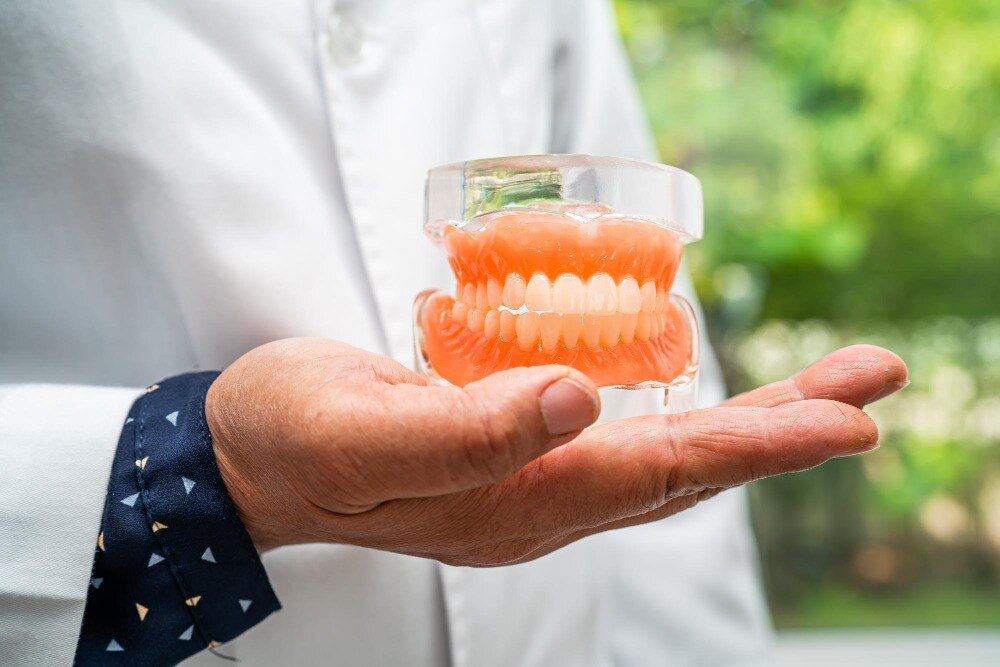
A complete denture replaces every natural tooth in one arch—upper, lower, or both with separate prostheses. A partial denture replaces some missing teeth and uses selected remaining teeth, gums, and bone for support, stability, and retention. The number of gaps matters, but it does not decide the design by itself.
| Option | Structural difference | Main support and concern |
|---|---|---|
| Complete denture | Replaces all teeth in one arch | Rests on the gums and underlying ridge; fit depends heavily on ridge shape and tissue health |
| Partial denture | Replaces some teeth while natural teeth remain | Uses rests, clasps, or a framework on suitable teeth; weak teeth may not safely support it |
A partial denture is not automatically suitable because only a few teeth are missing. Active decay, gum disease, looseness, short roots, unfavourable tooth positions, or inadequate bone can make those teeth unreliable supports. Placing a denture around untreated disease can increase plaque retention, damage supporting teeth, and shorten the appliance’s useful life.
Choosing dentures for missing teeth therefore starts with a clinical examination. The dentist assesses tooth restorability, periodontal health, ridge anatomy, bite, and radiographs when indicated.
For complete or partial dentures in Nashik, the practical choice also depends on chewing expectations, cleaning ability, tolerance for a removable appliance, budget, and willingness to consider extraction or implant treatment when remaining teeth cannot be maintained.
Which denture type matches your teeth, gums and daily needs?
Remaining teeth decide more than the number of gaps. A dentist must assess tooth strength, periodontal support, cavities, bone and gum health, bite, jaw anatomy and each tooth’s long-term prognosis. Radiographs may reveal roots or bone loss that make a seemingly useful tooth unsafe as a denture support.
| Option | Best fit | Main caution |
|---|---|---|
| Complete denture | All teeth in one arch are missing or cannot be predictably restored; the ridge can support a removable base | A loose ridge, strong gag reflex or difficult jaw anatomy can reduce stability and tolerance |
| Acrylic partial denture | Several teeth are missing, affordability matters, or a temporary appliance is needed during healing | It is bulkier, can load remaining teeth and gums, and needs careful cleaning |
| Cast-metal partial denture | Remaining teeth are strong, well-positioned and periodontally stable; you want a thinner, more durable framework | It costs more and requires precise design, healthy abutments and good hygiene |
| Flexible partial denture | Visible clasps are unacceptable and the remaining teeth provide suitable support and undercuts | It is harder to adjust or repair and may not distribute chewing forces ideally |
Your daily routine matters as much as the design. Limited finger control, poor oral hygiene or difficulty removing an appliance raises the risk of sore gums and decay; a strong gag reflex makes bulky palatal or posterior coverage harder to tolerate.
Begin by comparing complete dentures in Nashik or partial dentures in Nashik only after an examination considers function, budget, and your willingness to undergo implant surgery if greater stability is needed.
What happens from the first examination to final delivery?
Treatment starts with a clinical examination of your gums, remaining teeth, bite, jaw anatomy and the shape of the supporting ridge. The dentist checks periodontal health and tooth prognosis before planning a partial denture; active decay or gum disease must be treated first.
Radiographs are taken when they are needed to assess roots, bone, infection or teeth hidden below the gum. Your functional expectations, budget and willingness to consider surgery also influence the plan for complete or partial dentures in Nashik.
1. Impressions or digital scans record the tissues and remaining teeth. A laboratory uses this information to make the denture base and artificial teeth.
2. Bite registration records how your upper and lower jaws meet. Incorrect registration can produce an unstable denture, sore muscles or difficulty chewing.
3. During the try-in, you check tooth position, appearance, speech and comfort before the final acrylic processing. Ask for changes at this stage; later alterations are more limited.
4. At fitting, the dentist checks pressure points, borders, retention and your bite. You receive instructions for insertion, removal and cleaning, then return for adjustments if rubbing, looseness or speech problems appear.
Healing changes the timetable after extractions. An immediate denture can be inserted on extraction day, but shrinking gums and bone often require adjustments, a reline or replacement with a definitive denture. Final delivery follows once the tissues and fit are stable.
How do complete and partial dentures compare in real-life use?
A denture that feels secure while eating is not automatically the lightest, cheapest or most attractive option. The comparison depends on the arch, ridge shape, remaining teeth and how well the denture is maintained.
| Feature | Complete denture | Partial denture |
|---|---|---|
| Stability | Rests on gums; upper dentures usually gain suction, while lower dentures move more | Uses remaining teeth and tissues, with clasps, rests or precision attachments |
| Chewing | Restores function but biting force is lower than with natural teeth | Often feels more efficient because natural teeth still share the load |
| Speech | Needs adaptation, especially with bulky areas | Usually requires less adjustment, though clasps or added acrylic can affect speech |
| Appearance | Replaces the full visible tooth arrangement | Can look natural, but clasps and missing supporting teeth affect the result |
| Durability | Acrylic teeth and bases wear; repairs and relines are possible | Framework can last well, but clasp wear and damage to supporting teeth matter |
| Weight and cost | Often lighter and less complex; cost varies with materials and laboratory work | Cast-metal designs are thinner but can cost more than acrylic or flexible types |
Lower complete dentures have less natural suction than upper dentures, so tongue movement and ridge shrinkage can make stability difficult. Two-implant overdentures improve retention for suitable patients but remain removable and add surgery, maintenance and cost.
Immediate dentures go in on extraction day, then commonly need adjustment, relining or replacement as gums and bone heal. If supporting teeth under a partial become loose or are extracted, the denture may need repair, tooth addition, redesign or conversion to a complete denture.
Do not choose based on the phrase best dentures in Nashik alone. Compare dentures for missing teeth after an examination that checks tooth prognosis, gum health, bone, bite, ridge anatomy, budget and repair needs.
How do you protect the fit after choosing a denture?
Protect the fit by wearing the denture as instructed, eating soft foods in small bites, and returning for adjustments when pressure causes pain. During adaptation, speech, saliva and chewing feel different; chew on both sides and never file the appliance yourself.
A sore spot needs a clinical adjustment, not tolerance. Brush the denture with a denture brush and mild soap, rinse your mouth, and avoid hot water, bleach and household cleaners. Remove the denture overnight so the oral tissues can rest, then store it in water or the soaking solution your dentist recommends.
| Problem | What to do | Why it matters |
|---|---|---|
| Loose fit | Arrange an examination; use adhesive only as directed | Adhesive cannot repair a damaged or poorly fitting denture |
| Pressure or ulcer | Stop forcing the appliance and request an adjustment | Continued rubbing can injure the mucosa |
| Fit changes over time | Ask whether a reline is suitable | Gum and bone changes alter the supporting surface |
| Cracks, worn teeth or major looseness | Discuss repair or replacement | A temporary fix may not restore chewing or stability |
At Dr. Bhonsale's Dental Clinic & Implant Center, a Nashik consultation can compare complete dentures in nashik and partial dentures in nashik using your oral findings, remaining-tooth prognosis, functional expectations, budget and willingness to consider implants. “Best dentures in nashik” is not a universal material choice; fit and maintenance determine suitability.
Regular reviews remain necessary even without natural teeth.
Related service
Replacement of Missing Teeth (Complete & Partial Dentures) Dr. Bhonsale offers custom-made complete and partial dentures to replace missing teeth. View service → |
Frequently asked questions
What separates a complete denture from a partial denture?
A complete denture replaces every natural tooth in the upper arch, lower arch, or both. A partial denture replaces some missing teeth and uses remaining teeth, gums, and bone for support and stability.
Which denture type matches my teeth, gums, and daily needs?
The choice depends on the number and position of missing teeth, the condition of remaining teeth, gum and bone support, bite, comfort, appearance, speech, and how easily you can maintain the denture.
What happens from the first examination to final denture delivery?
The process includes an oral examination, treatment planning, impressions or digital scans, a trial arrangement when needed, fitting, bite and appearance checks, final delivery, and adjustment appointments.
How do complete and partial dentures compare in real-life use?
Complete dentures depend mainly on gum and bone support, while partial dentures also use clasps or other connectors around selected remaining teeth. Both require an adjustment period, daily cleaning, and periodic fit checks.
How do I protect the fit after choosing a denture?
Clean the denture and your mouth every day, handle it over a folded towel or basin of water, remove it as advised, avoid repairing it yourself, and arrange a review if it rubs, loosens, cracks, or affects chewing.
Keywords