The right choice depends on more than an implant brand or a promise of fast teeth. You will be able to compare replacement options, check whether your mouth and health support treatment, understand grafting and imaging decisions, and assess a clinic’s written plan before consenting.
Key takeaways
- Choose an implant only after comparing bridges, dentures and your cleaning ability.
- Check gum health, bone volume, bite, medical history and smoking before treatment.
- Ask whether bone grafting, a sinus lift or a short implant is necessary.
- Request the implant brand, components, maintenance plan and follow-up schedule in writing.
Should you choose an implant or another replacement?
An implant is not automatically the best replacement for every missing tooth. Choosing the right dental implant at a dental clinic in Nashik starts with the gap’s number and position, available bone, gum health, cleaning ability, speech, chewing, appearance and willingness to attend follow-up.
| Option | Best fit | Surgery, time, cost and maintenance |
|---|---|---|
| Implant-supported crown | One missing tooth with suitable bone | Higher upfront cost and surgical healing, but avoids preparing neighbouring teeth; clean around it and monitor for peri-implantitis. Failure may require removal, healing and replacement. |
| Conventional bridge | One or several teeth with strong neighbouring teeth | No implant surgery and usually faster, but requires reshaping support teeth. Clean under the bridge; failure can affect those teeth. |
| Implant-supported bridge | Several adjacent missing teeth | Fewer implants can support several teeth, reducing surgery compared with one implant per tooth. Costs and healing remain significant, with prosthetic repairs and implant maintenance required. |
| Overdenture | Multiple or all missing teeth with adequate support | Surgery and healing are required, but it is more stable than a removable denture. Remove it daily, clean attachments and attend adjustments; failure can reduce retention. |
| Partial or complete denture | Multiple or all missing teeth when avoiding surgery matters | Lower initial cost and no implant surgery, but daily removal, cleaning and periodic adjustment are necessary. Speech, chewing, looseness and ridge shrinkage can become problems. |
Plan the intended crown, bridge or denture position before selecting implant size or location. A dental clinic in Nashik should provide a written plan covering bone needs, treatment stages, maintenance and the response to failure. That plan makes choosing the right dental implant a clinical decision, not a brand preference.
What must be checked before a dental implant is considered?
1. Before a dental implant in Nashik is considered, the clinician must review your medical history, medications, diabetes control, previous healing problems, tobacco use, oral hygiene and periodontal history. Poorly controlled diabetes and smoking increase biological risk, but neither automatically rules out treatment.
2. Treat active decay, untreated gum disease and uncontrolled plaque before surgery. A history of periodontitis increases the risk of peri-implantitis and implant loss; it does not automatically exclude an implant, provided the disease is controlled and followed by supportive periodontal care. The implantologist in Nashik should document tobacco use and provide cessation guidance.
3. The examination should include periodontal probing, soft-tissue and bone assessment, bite analysis and checks for clenching or grinding. It must also assess adjacent roots and the intended crown, bridge or denture shape, because placing an implant before planning the final tooth can leave it difficult to restore or clean.
Intraoral scans or impressions and dental X-rays document that restorative plan.
4. Three-dimensional CBCT is justified when two-dimensional X-rays cannot answer a specific anatomical question, such as the position of the inferior alveolar nerve or maxillary sinus. Request the smallest field of view and lowest exposure that provide adequate information; routine CBCT without a clinical indication adds radiation without improving the decision.
When are bone grafting, sinus lifts or short implants needed?
If available jawbone cannot safely support the planned implant position, bone grafting, a sinus lift or a shorter implant may change the plan. Bone grafting adds material to a deficient ridge so the implant can sit beneath the planned crown and remain cleanable.
The graft needs healing before implant placement, or placement can occur alongside grafting when the defect and initial stability permit.
| Option | What it does | When it fits | Main trade-off |
|---|---|---|---|
| Bone grafting | Builds ridge height or width | The planned implant position lacks sufficient bone | Adds a healing stage and surgical site |
| Sinus lift | Raises the maxillary sinus floor and places graft beneath it | The upper back jaw lacks vertical bone height | Adds procedure-specific healing and sinus risks |
| Short implant, about 5–8 mm | Uses the existing posterior bone with less implant length | Width, diameter, bone quality and loading conditions are suitable | Not a universal substitute for augmentation |
Treatment time depends on the defect, graft method, healing response and whether placement is simultaneous. Ask a dental clinic in Nashik for a stage-by-stage schedule covering grafting, implant placement, integration and loading, rather than a guaranteed completion date.
The plan must show the inferior alveolar nerve, maxillary sinus, adjacent roots and facial bone. For a front tooth, socket anatomy, tissue thickness, provisional tooth and emergence profile matter as much as integration; a dental implant in Nashik can integrate successfully yet look poor if positioned too far facially or without soft-tissue support.
How should you compare implant components, designs and materials?
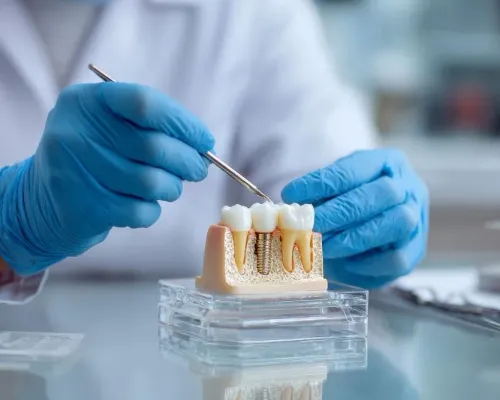
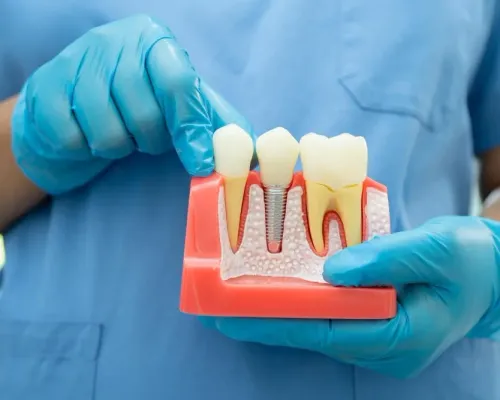
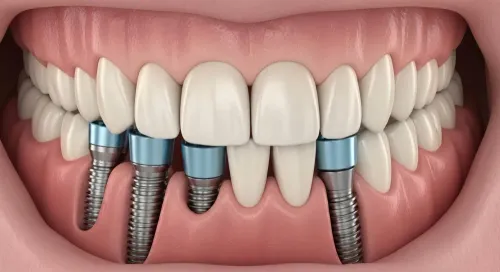
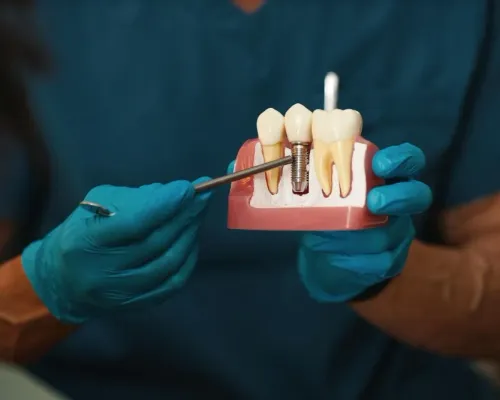
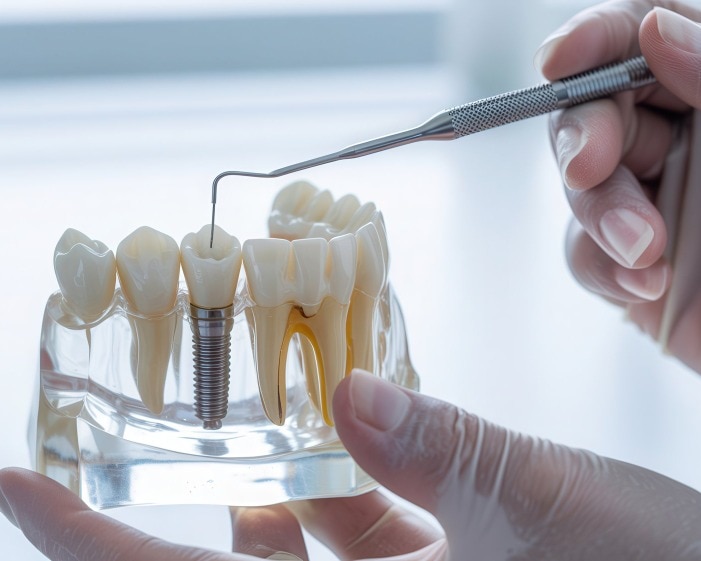
Compare the complete system, not just the fixture or brand name. A dental implant has a fixture anchored in bone, an abutment connecting it to the restoration, and a crown visible in your mouth.
Titanium fixtures have the largest evidence base. Zirconia fixtures suit selected cases, but zirconia systems offer fewer long-term component choices. Ask why the proposed diameter and length fit your available bone, bite forces and planned crown position. Surface treatment influences bone attachment; it does not replace assessment of placement, loading and maintenance.
For the visible crown, compare materials against the site and functional demands:
| Material | Strengths and considerations | Compare it for |
|---|---|---|
| Porcelain-fused-to-metal | Established option; metal may affect appearance at the gum edge | Posterior teeth, bite forces and tissue display |
| Zirconia | Tooth-coloured ceramic with different strength and translucency options | Front or back teeth, fracture risk and opposing teeth |
| Other ceramic designs | Appearance and mechanical properties vary by design | Cleaning access, space and the final tooth shape |
For an anterior tooth, judge the planned implant position, tissue thickness, soft-tissue contour and emergence profile—not only the crown shade. A well-integrated implant can still look poor if it sits too far toward the lip or too deep.
Ask for these records before treatment:
- Manufacturer and implant model
- Fixture diameter and length
- Abutment and crown compatibility
- Lot or batch documentation
Traceability helps if a screw loosens, a component fractures or replacement is needed. During a dental implant in Nashik consultation, ask the implantologist in Nashik to explain the prosthetic plan and maintenance demands in writing. Brand recognition alone cannot prove anatomical or restorative suitability.
What should a Nashik clinic’s treatment plan and follow-up include?
A clear written plan should let you identify every stage, responsible clinician, component and review date before consenting to treatment.
1. Check that the plan names the implant system, fixture, abutment and crown components; the number and positions of implants; extraction and healing steps; any grafting or sinus procedure; provisional and definitive restorations; expected osseointegration period; loading plan; maintenance schedule; and the response if integration fails.
2. Treat extraction, immediate implant placement, osseointegration, abutment connection and crown delivery as separate stages. An implant placed in a fresh socket does not automatically receive an immediate crown. Immediate loading requires primary stability, suitable bone, controlled occlusion and manageable functional risk, not simply a request for teeth in one day.
3. Ask who performs surgery and restoration, which recognised dental qualification and implant-specific training they hold, and how the team manages nerve injury, sinus complications, infection, failed integration, screw loosening, ceramic fracture and peri-implantitis. “Implantologist in Nashik” is not enough without these answers.
4. Require follow-up that teaches plaque control, schedules professional maintenance and checks bleeding, probing changes, suppuration, mobility and prosthetic problems. Implants do not become maintenance-free after integration.
5. Compare this document—not a brand name or headline success percentage—when reviewing an implant centre in Nashik. Dr. Bhonsale's Dental Clinic & Implant Center can be assessed alongside any dental clinic in Nashik using the same written-plan and clinician-verification checklist.
Related service
Replacement Of Missing Tooth Or Teeth Dental implants are permanent solutions for missing teeth, designed to mimic natural tooth roots and provide a strong foundation for fixed or... View service → |
Frequently asked questions
Should you choose a dental implant or another replacement?
Compare an implant with a fixed bridge or removable denture using the number and position of missing teeth, bone, gum health, cleaning ability, appearance, chewing, speech and follow-up commitment.
What must be checked before a dental implant is considered?
Your dentist should assess gum health, available bone, bite, neighbouring teeth, oral hygiene, medical history, smoking and your ability to attend treatment and maintenance visits.
When are bone grafting, sinus lifts or short implants needed?
Bone grafting adds support when the jaw lacks sufficient volume. A sinus lift raises the sinus floor for implants in the upper back jaw. A short implant is an alternative when limited bone height makes a longer implant unsuitable.
How should you compare dental implant components and materials?
Ask about the implant system, implant material, surface, diameter, length, connection, abutment and crown material. Compare documented suitability, cleaning access, repair options and long-term maintenance rather than choosing by brand name alone.
What should a Nashik dental clinic’s treatment plan and follow-up include?
Request a written plan covering examination and imaging, extraction or grafting, implant placement, healing, crown delivery, fees, risks, hygiene instructions, review visits and the process for handling complications.
Keywords